
5 Business Strategy Tools To Help Grow Your Business

In the ever-changing business environment, it is of paramount importance to have a clear vision of the direction in which the business is heading. Mere offering of a good product or service is not enough; one must have to study the competition, know one’s strengths and weaknesses and plan ahead. Fortunately, there are several strong business strategy tools, which can be helpful when it comes to this task. Below are five important tools that every business should use in order to grow the business to its potential.
1. SWOT Analysis: Understanding Your Internal and External Environment
SWOT analysis is one of the most important tools to assess the current position of the business organization. It is a strategic management tool that helps one to determine the strength, weaknesses, opportunities and threats that are available. Strengths are those activities that are well done or resources that are at your disposal that can make you stand out. Flaws are the specific activities or capabilities which are less effective in your case than in the case of competitors or those that require enhancement. Chances are the events or conditions in the external environment that can be capitalized on, for instance, new markets or shifts in customer preferences. Threats are all the factors that may harm the business in some or the other way, for instance the entry of new competitors or a change in the business cycle.
SWOT analysis is a powerful tool that helps a business owner to get a good understanding of the current state of his business and make wise decisions on the further actions and resources allocation. This tool enables you to leverage strengths, manage weaknesses, exploit opportunities and counter threats so as to enhance growth and competitiveness.
2. Porter’s Five Forces: Analyzing Industry Attractiveness
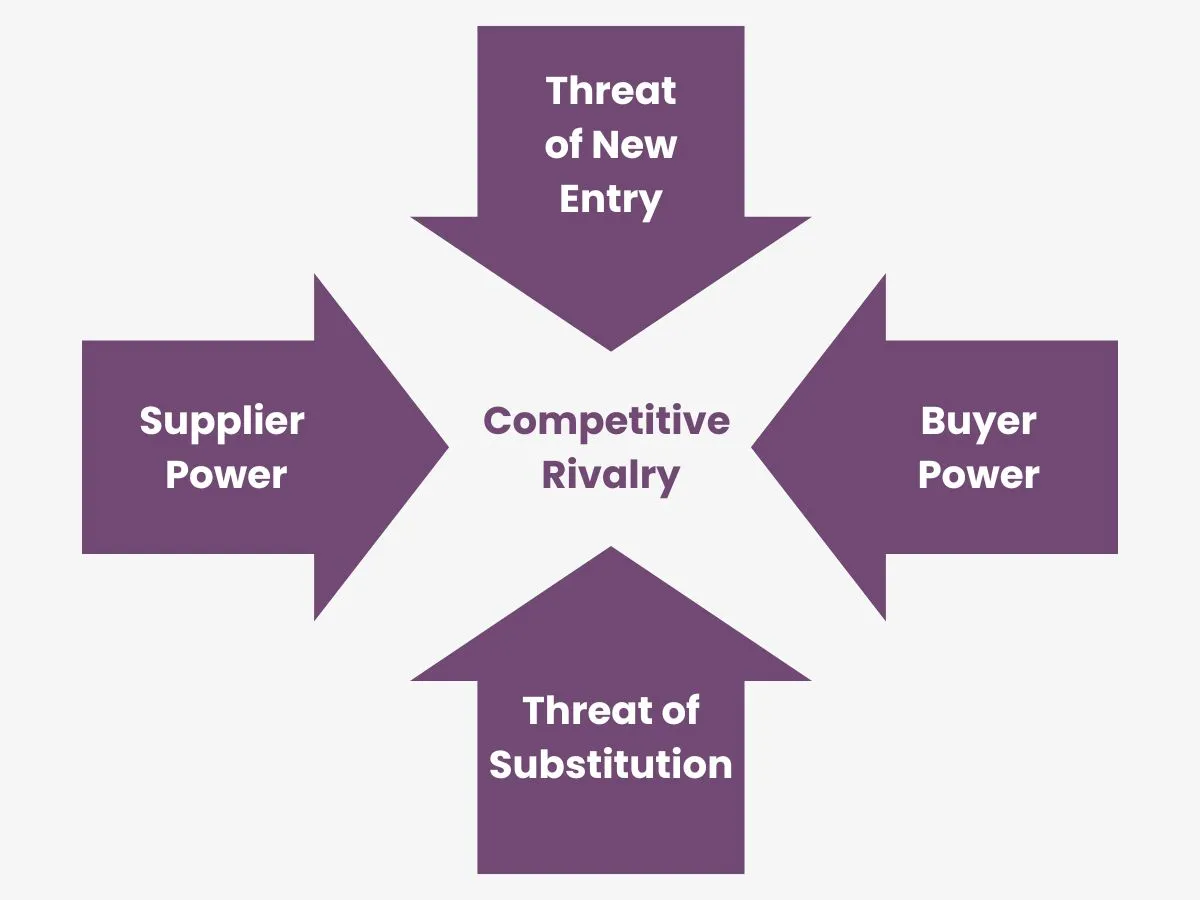
Porter’s Five Forces is a model that is used to understand the competitiveness of an industry and its attractiveness. It outlines five forces that define the structure of an industry and its profitability.
- Threat of New Entrants: New entrants into the market are a threat because it is easy for new competitors to enter the market.
- Bargaining Power of Suppliers: How much influence do your suppliers have over the price and the condition they offer?
- Bargaining power of Buyers: How much leverage do your customers have in asking for lower price or better quality?
- Threat of Substitute Products or Services: How much can customers switch to other products or services?
- Competitive Rivalry Among Existing Firms: How cutthroat is the competition in the current market among the current players?
By so doing, you can determine the competitive advantage of your industry and the threats that are likely to affect your business. The information provided here enables one to formulate the ways of protecting the market share, strengthening the position and taking advantage of the opportunities in the industry.
3. Value Chain Analysis: Optimizing Operations and Creating Value
The value chain analysis is a tool that identifies all the activities your business undertakes to create value for the customer right from the inputs to the outputs. It is therefore important to look for ways of improving these activities, cutting costs and at the same time increasing the value of the product to the customer. By using this analysis, you will be able to know the areas where you can do better and where you can stand out from the competition.
This is because by implementing the value chain in your business, you are able to cut down on costs, satisfy the needs of the customers, and thus enhance the business’ profitability. This tool will be very useful for any business that is concerned with efficiency and wants to add value to the business.
4. Blue Ocean Strategy: Creating Non-Competitive Space

Blue Ocean Strategy is a strategy that is in contrast to the conventional strategy that focuses on the existing competition by encouraging the creation of new market space, referred to as blue oceans. Instead of focusing on the existing market space where competition is already prevalent, which is referred to as “red oceans”, the focus should be on creating new ones. This refers to the process of creating value by recognizing the unsatisfied customer needs and finding ways of satisfying them.
Therefore, by using the blue ocean strategy, you can avoid direct competition, set high price and gain the leading position in the market. This strategy is especially useful for companies that are planning to enter a specific industry and shake it up or even generate a new one.
5. Balanced Scorecard: Measuring Performance Across Multiple Dimensions
The Balanced Scorecard is a tool of performance management that is used to measure organizational performance not only in financial terms but in other areas as well. It usually contains four major dimensions:
- Financial: How do we appear to the shareholders? (e.g., revenue, profit)
- Customer: What do customers perceive us as? (e.g., customer satisfaction, market share)
- Organizational Activities: What must be done well? (e.g. internal operations)
- Continual Learning and Development: How can we keep on enhancing and creating value? (e.g., enhancing employee competencies, innovation).
When evaluating performance on these dimensions, one is able to get a broad perspective of the business success. The BSC is a strategic management system that both directs your actions and measures your performance against the strategic plan. It is helpful to any organization that seeks to pursue sustainable growth and development for the creation of value.
These five business strategy tools are helpful to understand your business, your industry and the competition better, if applied. This knowledge enables you to implement proper and efficient strategies to enhance operations and growth. It is important to understand that these tools are not universal and should be adjusted to the particular context of the business and used in combination with the knowledge of the business owner.